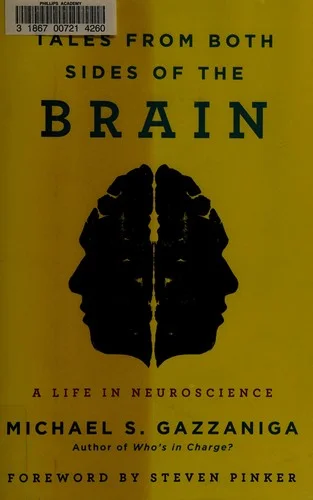
Why read it — Most people assume the self is singular — one “I” making decisions. Gazzaniga’s split-brain research dismantles this. Through decades of work with patients whose hemispheres were surgically separated, he reveals that the mind is modular, and what we call “consciousness” is largely a left-hemisphere interpreter spinning narratives to make sense of what the other modules already decided. If you’re building AI, designing systems, or just trying to understand why you do things you can’t explain — this reframes the question.
Cross-domain lens — The book lives at the intersection of neuroscience and philosophy, but its architecture maps directly onto systems design. The brain is a modular, distributed system with an “interpreter” — a PR layer that constructs coherent narratives from fragmented signals. Sound familiar? Modern AI faces the same challenge: multiple specialized models, no unified self, and the eternal question of who’s “driving.” Gazzaniga’s patients show what happens when the interpreter gets disconnected — two parallel processors with different preferences, different beliefs, sometimes different personalities.
Stack Takeaway
- The unified self is an illusion constructed by an interpreter — a post-hoc storyteller, not a decision-maker.
- If you’re designing AI systems or studying cognition, the question isn’t “where is the self?” but “where is the interpreter?”