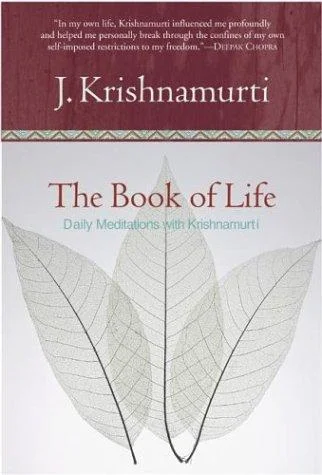
Why read it — Krishnamurti is one of the few thinkers who insisted on doing philosophy in real time rather than in doctrine. The Book of Life is a year of daily passages, each circling the same core problem from a slightly different angle: that the self doing the observing is the same self creating the confusion, and that most of what we call knowledge is conditioned response wearing the costume of understanding. This is not comfortable reading. It is useful precisely because it refuses the consolation of a system.
Cross-domain lens — The book is philosophy and education in its tags, but its deepest current is cognitive and psychological: Krishnamurti is asking what it would mean to perceive without the filter of accumulated conditioning. That question has a direct counterpart in systems thinking—most organizational and institutional failures are not information failures but perception failures; the system sees what it was built to see. The self layer connects to education: he was deeply concerned with how schooling produces people who can pass exams but not question the frameworks the exams test. Where the book is weakest is precisely where it is most ambitious — it offers clarity about the problem with almost no account of structural or collective conditions.
Stack Takeaway
- Conditioned thought is the human equivalent of a cached response: fast and efficient, but increasingly wrong as the environment changes and the cache goes stale.
- Perception and observation are not passive — they are shaped by the frameworks we inherit, and those frameworks are the first thing worth examining in any failing system.