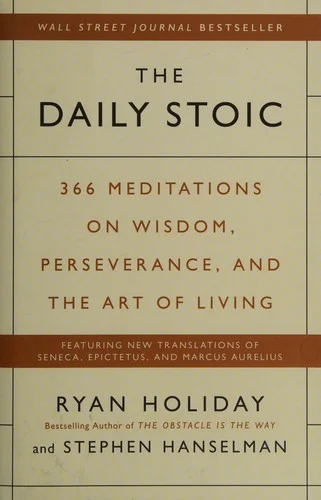
Why read it — Stoicism is often sold as resilience training, which undersells it. Holiday and Hanselman’s curation makes the actual argument more visible: Stoicism is a practice, not a belief system, and the practice is fundamentally about the boundary between what you control and what you don’t. In a world that generates extraordinary quantities of ambient anxiety about things entirely outside individual influence, that boundary is one of the most practically useful ideas available. The daily format forces the philosophy out of the realm of abstraction and into the texture of actual days.
Cross-domain lens — The tags are philosophy, practice, and resilience, and the cross-domain connection runs into psychology and decision-making. The Stoic distinction between “up to us” and “not up to us” is a cognitive parsing tool as much as a moral one — it is functionally equivalent to what systems thinkers call identifying leverage points versus noise. The resilience layer connects to economics: Stoic indifference to externals is not passivity but a strategy for maintaining agency under conditions of radical uncertainty, which is the condition most institutions and individuals now operate in permanently. Where the book is occasionally thin is on collective action — Stoicism scales well to individuals, less cleanly to institutions.
Stack Takeaway
- The Stoic practice of distinguishing control from non-control is a cognitive hygiene protocol — applied consistently, it reduces the noise-to-signal ratio in decision-making under uncertainty.
- Resilience at scale requires this distinction to be embedded in institutional practice, not just personal habit; most institutions do the opposite.