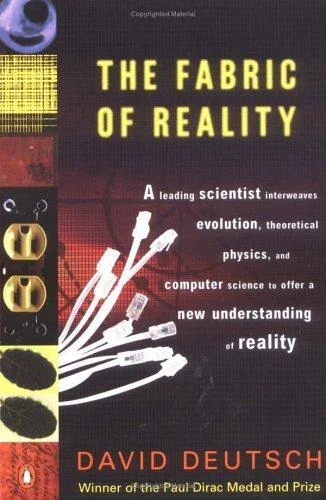
Why read it — Most popular physics books either sell mystery or sell certainty. Deutsch does neither: he argues that the deepest physical ideas only make sense when you treat knowledge — how explanations are created, tested, and extended — as part of the same world as particles and fields. The book asks what kind of universe could produce science at all, and pushes that question into quantum theory, evolution, and computation without dumbing them down into metaphors alone.
Cross-domain lens — Deutsch braids four “strands” (quantum theory, epistemology, evolution, computation) into one fabric. Computation stops being a gadget-layer on physics and becomes a constraint on what transformations are possible; evolution becomes a search process in the space of knowledge, not only genes; quantum mechanics is read as evidence about how information and reality entangle. The human layer is explicit: progress is not accumulation of data but improvement of explanatory power — a claim that sits uncomfortably with both naive scientism and post-truth cynicism.
Stack Takeaway
- A universe compatible with error-correction and open-ended explanation is a different object than a universe “described by equations” in the passive voice — epistemology becomes a load-bearing part of the stack, not commentary on it.
- Where many books separate “hard science” from “how we think,” Deutsch’s wager is that the separation is what obscures the deepest structure.