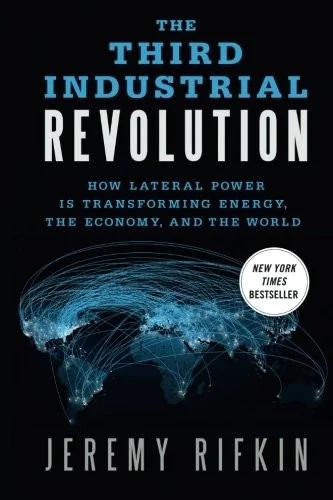
Why read it — Rifkin frames the next industrial era as an energy-communications convergence: renewable generation, smart grids, and lateral (peer-style) infrastructure replacing top-down fossil hierarchies. It is the earlier, more infrastructure-forward sibling to his zero-marginal-cost thesis. Even if you dispute the politics or pace, the book is useful for seeing the grid and the internet as one coupled system rather than two separate stories.
Cross-domain lens — Energy and economics anchor the argument; the human and institutional layers are where implementation lives—permitting, utilities, labor, and who pays for stranded assets. Digitization is the coordination layer: demand response, metering, logistics. The physical constraint is blunt: electrons and heat still obey geography and seasonality; software cannot wish that away.
Stack Takeaway
- Industrial revolutions are as much governance and finance transitions as technology transitions—hardware without a bill-payment and incentive stack stalls in pilot purgatory.
- Distributed energy is a topology change: it shifts leverage from centralized producers to whoever controls interfaces, standards, and dispatch—often a quieter form of concentration than smokestacks.