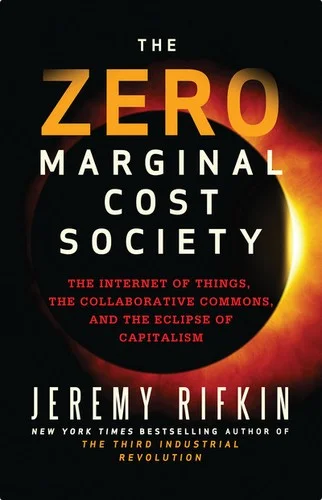
Why read it — Rifkin asks what happens when the marginal cost of reproducing and distributing many goods trends toward zero—digitally first, then (he argues) physically via renewables and 3D-style production. The book is speculative and uneven on timing, but the core economic question is sharp: if price chases marginal cost, what remains of profit, employment, and the firm? You read it less for forecasts than for a vocabulary for abundance as a design constraint.
Cross-domain lens — Economics and technology interlock: networks, sensors, and energy infrastructure change the cost curves; institutions (property, regulation, taxation) lag. The digital layer is the proof-of-concept—information goods already live the zero-marginal-cost world. The physical layer is where the argument strains: energy and atoms still have limits, maintenance, and geography. Rifkin’s blind spot is power: who owns the platform when marginal cost falls but fixed cost and data rents do not.
Stack Takeaway
- Zero marginal cost is a selective phenomenon—often paired with rising fixed cost, lock-in, and rent at the bottleneck.
- “Prosumer” abundance without redesigned ownership is just a new shape of extraction wearing a sharing-economy costume.