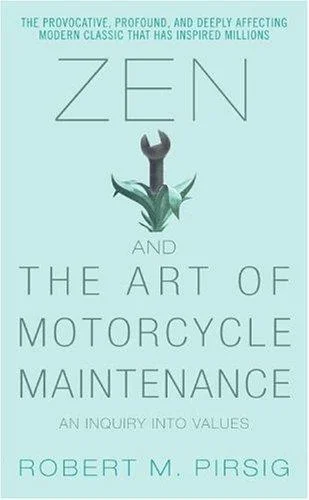
Why read it — Pirsig’s real subject is not motorcycles or Zen—it is the rupture between the classical and romantic modes of understanding, and the cost of letting that rupture go unexamined. The classical mode wants to know how things work; the romantic mode wants to know how things feel; Pirsig argues that the split itself is a pathology, and that Quality—his deliberately unresolved central concept—is what exists before the split happens. This is a philosophical argument dressed in a road novel, and it lands differently at different stages of a life.
Cross-domain lens — The tags are philosophy, quality, and technology, and the cross-domain tension is exactly the one the book explores: the person who understands the machine is often estranged from the person who experiences the ride. That maps cleanly onto the gap between engineering and design, between systems that work correctly and systems that feel right. The technology layer is not incidental — Pirsig was writing at a moment when technical rationality had become the dominant epistemology, and he was asking what it costs to have no language for what it can’t measure. The economic implications are indirect but real: Quality as a pre-analytical category is what markets are supposed to aggregate and consistently fail to.
Stack Takeaway
- The classical/romantic split is not a personality difference — it is an institutional and epistemological divide that most organizations reproduce without knowing it, usually to the detriment of the work.
- Quality cannot be fully specified in advance; any system that only rewards what it can measure will systematically degrade what it cannot.